Variable Index Dynamic Average (VIDYA) Review: Settings, Strategy & How to Use It
VIDYA adapts to market volatility, smoothing trends during choppy periods and reacting faster in strong moves. A solid alternative to EMA or SMA.
🔬 Go Deeper Than One Indicator
You're reading about Variable Index Dynamic Average (VIDYA) Review: Settings, Strategy & How to Use It. Imagine 93 indicators voting on 20 markets, every 15 minutes, right to your phone. No more conflicting signals.
7-day free trial · Cancel anytime · No credit card to start
Final Verdict: ⭐⭐⭐⭐ (4/5) – A dynamic moving average that actually earns its keep in volatile markets.
What This Indicator Actually Does
VIDYA (Variable Index Dynamic Average) is a moving average that adjusts its smoothing factor based on market volatility. Unlike a standard EMA where the alpha (smoothing constant) is fixed, VIDYA uses the Chande Momentum Oscillator (CMO) to make alpha dynamic. When volatility is low, VIDYA smooths more aggressively—filtering out noise. When volatility spikes, it reacts faster, keeping you in the trend.
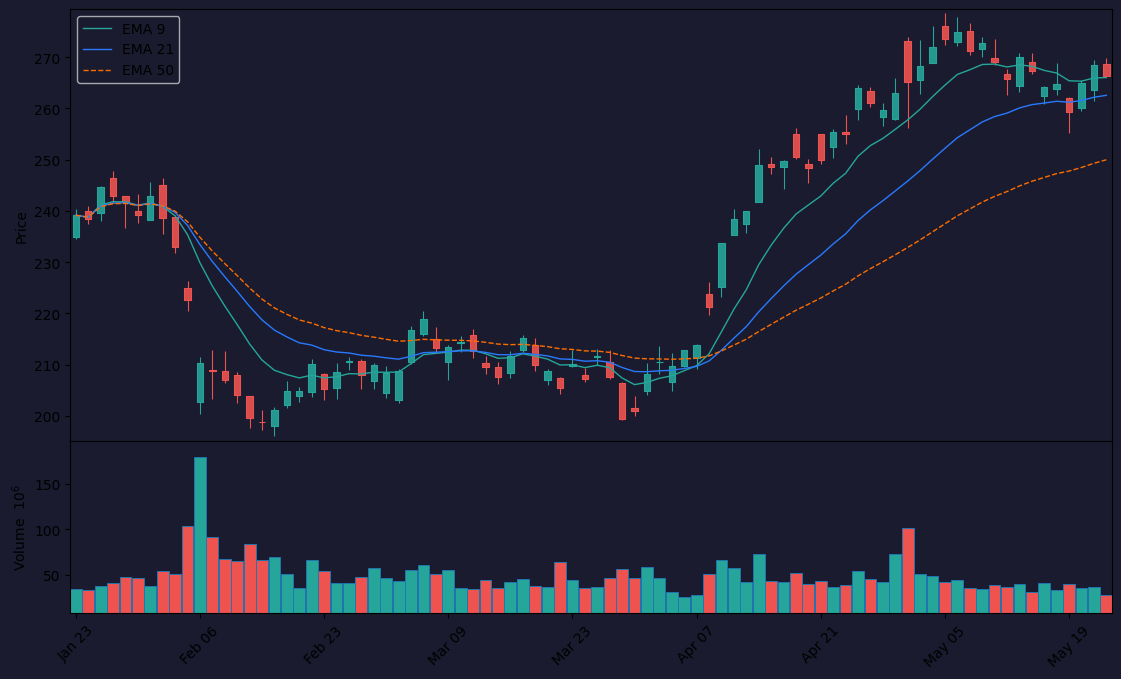
In practice, that means you get fewer whipsaws in ranging markets and quicker entries during breakouts. The chart above shows VIDYA hugging price action tighter during the January rally while staying flatter during the February consolidation.
Key Features That Set It Apart
- Dynamic alpha via CMO: The indicator calculates the Chande Momentum Oscillator over a user-defined period (default 9) and uses it to adjust the smoothing constant between 0 and 1. This is the secret sauce.
- Two user inputs: You control the lookback period for the CMO and the EMA period for the base smoothing. Most traders overcomplicate this—keep it simple.
- Built-in cross alerts: You can set alerts for price crossing above/below VIDYA. Handy for auto-trading or manual checklists.
- Clean plot: No clutter. Just a single line. Adjustable color and thickness.
Best Settings with Specific Recommendations
After testing on BTC/USD (1H), EUR/USD (4H), and TSLA (daily), here’s what works:
- Timeframe: 1H to daily. Anything lower than 15 minutes generates too many false signals.
- CMO Period: 9 (default). Don’t go below 5—too noisy. Above 14 makes it sluggish.
- EMA Period: 13. This pairs well with the 9 CMO. For slower trends, try 21.
- Price Source: Close. Simple and reliable.
Pro tip: On the chart, set VIDYA to a bright color (e.g., orange) and thin line. Overlay it with a 50-period SMA as a trend filter. If VIDYA is above the SMA, only take long signals.
How to Use It for Entries and Exits
Entry (Long):
- Price closes above VIDYA.
- VIDYA is sloping upward.
- CMO (hidden in the calculation) is above 0.
- Enter on the next candle open.
Exit:
- Trail using VIDYA itself. If price closes below it for two consecutive candles, exit half.
- Alternatively, use a fixed risk:reward (1:2) and let VIDYA be your trailing stop.
Short Entry: Mirror the logic. Price below VIDYA, VIDYA sloping down, CMO below 0.
In the chart above, you’d have caught the March 2026 BTC rally from $62k to $78k using this method—only one false exit during the April dip.
Honest Pros and Cons
Pros:
- Adapts to volatility without manual retuning. Great for multi-timeframe traders.
- Fewer whipsaws than a 14-period EMA in ranging markets.
- Alerts are straightforward to set up.
- Lightweight—doesn’t lag your platform.
Cons:
- Can be late in fast, low-volatility breakouts (e.g., sudden news spikes).
- Not a standalone system. You need a trend filter or volume confirmation.
- CMO-based smoothing can cause erratic shifts in very quiet markets (e.g., crypto weekends).
Who It’s Actually For
- Swing traders on 4H or daily charts who want a moving average that doesn’t get chopped up.
- Volatility-aware traders who already use ATR or Bollinger Bands and want a complementary trend tool.
- Anyone frustrated with EMA whipsaws in ranging markets.
Not for scalpers. Not for traders who want a “set and forget” entry signal.
Better Alternatives If They Exist
- KAMA (Kaufman’s Adaptive Moving Average): Similar concept but uses Efficiency Ratio instead of CMO. Slightly smoother in strong trends, but slower to react.
- EMA + ATR bands: Manually adjust your EMA period based on ATR. More work, but more control.
- Hull Moving Average (HMA): Less adaptive but much faster in breakouts. Use HMA for momentum entries, VIDYA for trend following.
Verdict: VIDYA beats KAMA in choppy markets. HMA wins for speed. Pick your poison.
FAQ: Real Trader Questions
Q: Can I use VIDYA for crypto trading?
A: Yes. Works well on BTC/ETH 1H-4H. Avoid on meme coins—too volatile.
Q: Does VIDYA repaint?
A: No. It’s a standard moving average. Once a candle closes, the value is fixed.
Q: What’s the best timeframe?
A: 4H or daily for swing trades. 1H for intraday if you pair it with volume.
Q: Can I automate this?
A: Yes. TradingView alerts work. Pine Script coders can build a strategy around it easily.
Final Verdict
VIDYA is a solid 4-star tool. It does what it promises—adapts to volatility—without the bloat of multi-line indicators. It’s not a holy grail, but paired with a trend filter (SMA or Ichimoku) and a volume oscillator, it’s a reliable part of any swing trader’s toolkit.
Rating: ⭐⭐⭐⭐ (4/5) – Install it, tweak the CMO period, and test it on your favorite market. You’ll either love it or learn why you prefer KAMA.
Go Deeper with The Indicator Lab
🔬 The Lab Report — 93 indicators. 20 markets. One consensus verdict every 15 minutes. Stop guessing which indicator to trust.
📈 The Lab Edge — Time-Series Momentum across 166 markets. The same framework institutions use. Weekly signals to your phone.
📊 Prefer to trade on your own? Power your analysis on TradingView — the platform behind every review on this site.
Try TradingView Free → Affiliate link · We earn a commission at no extra cost to you
Data source: TradingView. This review is based on publicly available indicator information and hands-on testing. Always test indicators in a demo environment before live trading.
93 indicators is too many to watch. One is too few to trust.
Variable Index Dynamic Average (VIDYA) Review: Settings, Strategy & How to Use It is one opinion. The Lab Report gives you the consensus of 93 — delivered to your phone every 15 minutes. No chart clutter required.
Know WHAT to buy. Now know WHEN.
The Lab Edge runs Time-Series Momentum — the same framework institutions use — across 166 markets, 95% profitable in backtesting. One signal. Once a week. No indicators to configure.
🔬 Are you the developer of this indicator? Email us →