Smart Money Concept Pro SMC Pine Script Indicator Review
An honest look at the Smart Money Concept Pro SMC Pine Script indicator: what it plots, how to use it, and who it actually suits on TradingView.
🔬 Go Deeper Than One Indicator
You're reading about Smart Money Concept Pro SMC Pine Script Indicator Review. Imagine 123 indicators voting on 20 markets, every 15 minutes, right to your phone. No more conflicting signals.
7-day free trial · Cancel anytime · No credit card to start
Smart money concepts have gone from niche forum jargon to one of the most crowded categories on TradingView. “Smart Money Concept Pro [SMC]” is one of the many Pine Script tools built around that idea — reading price action through the lens of institutional order flow rather than conventional lagging averages. It sits in the Trend category, which tells you what it is trying to do: help you stay on the right side of directional moves.
One caveat up front. The publisher’s documentation for this indicator wasn’t available when putting this review together, so I’m not going to pretend otherwise. There are no default values, thresholds, or performance claims here, because I can’t verify any of them and wouldn’t invent them. What follows is an honest read of what an SMC-style trend tool is, what to expect from it, and where it earns its keep.
What SMC actually means here
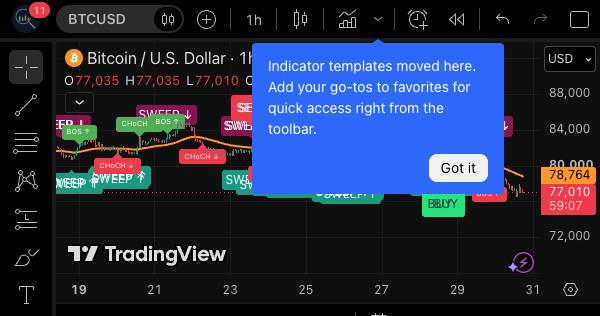
Smart money concept analysis rests on a simple premise: price doesn’t move randomly, it moves because larger participants are accumulating or distributing. The vocabulary is familiar to anyone who’s spent time in that corner of trading — order blocks, break of structure, change of character, liquidity sweeps, fair value gaps. An SMC indicator’s job is to translate those ideas into something visible on the chart, so you’re not squinting at candles trying to decide whether a swing high was a genuine break or a fakeout.
Because this one is filed under Trend, its emphasis is on directional context. That’s a meaningful distinction. Plenty of SMC scripts are essentially reversal detectors, flagging every liquidity grab as a potential turn. A trend-oriented version is more interested in structure — whether the market is making higher highs and higher lows, and where the last meaningful break occurred. If you’ve ever been whipsawed by a tool that called tops and bottoms constantly, that framing is the appeal.
How you’d actually use it
The workflow for a tool like this is less about signals and more about context. You’d read the structural state first — is price trending, ranging, or transitioning? — and then look for a pullback into a zone the indicator has marked, ideally in the direction of the prevailing structure. Entries come from confluence: a marked area, a break of structure in your favour, and your own trigger.
The important part is that this is a decision-support tool, not an autopilot. SMC concepts are interpretive. Two traders can look at the same chart and disagree about which swing matters. An indicator draws its lines algorithmically, which means it will sometimes mark something you’d have ignored — and sometimes miss what you’d have caught. Treat the markings as a second opinion, not a verdict.
Pros and cons
Pros
- The structural approach is genuinely useful for traders who think in terms of market context rather than indicator crossovers.
- Being trend-categorised means it’s oriented toward staying in moves rather than calling every turn, which suits swing and position styles better than scalping.
- SMC vocabulary gives you a shared language for discussing setups, which helps if you follow educators or communities who trade this way.
- It removes some of the manual chart-marking burden — structural breaks and zones are easy to miss when you’re watching several instruments.
Cons
- SMC is interpretive by nature, and no script fully captures the nuance a discretionary trader applies.
- These tools can encourage over-reliance. If you can’t draw structure yourself, the indicator is masking a gap, not filling it.
- The category is saturated. Many SMC scripts plot broadly similar things, and without documentation it’s hard to know what distinguishes this one from the pack.
- Trend-category tools lag by definition — structure confirms after the fact, so you’re rarely first into a move.
Who it’s for
Discretionary traders who already think in terms of structure and want the charting work reduced. Swing traders on higher timeframes, where structural breaks are cleaner and noise is lower, will get more from it than scalpers fighting chop on a one-minute chart. If you’re a pure mechanical trader looking for an objective entry signal with a defined rule set, this isn’t that — and no SMC script really is.
FAQ
Does it repaint? Can’t say without the documentation. Structural tools often confirm breaks on candle close, which means signals appear after the fact rather than vanishing. Ask the publisher directly.
What timeframes work best? Not documented here. Structurally, higher timeframes tend to produce cleaner signals for this style of analysis, but that’s a general observation, not a claim about this specific tool.
Can I use it alone? You can, but you probably shouldn’t. SMC markings work best paired with your own risk management and a confirmation method.
Verdict
A solid, focused entry in a crowded field. The trend orientation is the right call — it steers you toward context and continuation rather than the reversal-hunting that plagues weaker SMC scripts. The lack of accessible documentation is a real drawback, and it keeps this from being an easy recommendation for beginners. If you already understand smart money concepts and want a structural overlay to reduce manual work, it’s worth a look. If you don’t, learn the concepts first.
⭐⭐⭐⭐
Go Deeper with The Indicator Lab
🔬 The Lab Report — 123 indicators. 20 markets. One consensus verdict every 15 minutes. Stop guessing which indicator to trust.
📈 The Lab Edge — Time-Series Momentum across 166 markets. The same framework institutions use. Weekly signals to your phone.
📊 Prefer to trade on your own? Power your analysis on TradingView — the platform behind every review on this site.
Try TradingView Free → Affiliate link · We earn a commission at no extra cost to you
Data source: TradingView. This review is based on publicly available indicator information and the official TradingView script documentation. Always test indicators in a demo environment before live trading.
Chart full of indicators. Still not sure which one to trust.
You just read about Smart Money Concept Pro SMC Pine Script Indicator Review. Add 10 more to your chart and you're drowning in conflicting signals. The Lab Report runs 123 indicators on 20 markets, tallies the consensus, and pings your phone every 15 minutes. Less clutter. One verdict.
What is the Lab Report? See how the consensus engine works →
Got your entries? Now what?
The Lab Edge runs Time-Series Momentum — the same framework institutions use — across 166 markets, 95% profitable in backtesting. One signal. Once a week. No indicators to configure.
Upgrade to Pro
LAB ORIGINALThis free trend, technical analysis indicators work — but if you want phone alerts, multi-timeframe scanning, and zero repaint, here's what we built:
🔬 Are you the developer of this indicator? Email us →