Algoz Pro Price Action Review — Trend Indicator
Algoz Pro Price Action review: a trend-following TradingView indicator built around classic price action. What it does, who it suits, and the trade-offs.
🔬 Go Deeper Than One Indicator
You're reading about Algoz Pro Price Action Review — Trend Indicator. Imagine 123 indicators voting on 20 markets, every 15 minutes, right to your phone. No more conflicting signals.
7-day free trial · Cancel anytime · No credit card to start
Price action indicators are a crowded category on TradingView, and most of them are repackaged moving averages with a new coat of paint. Algoz Pro Price Action sits in the trend category and, based on what’s publicly documented, aims at reading market structure and direction rather than firing off a single line. Here’s an honest look at what it is and whether it earns a spot on your chart.
What this indicator actually does
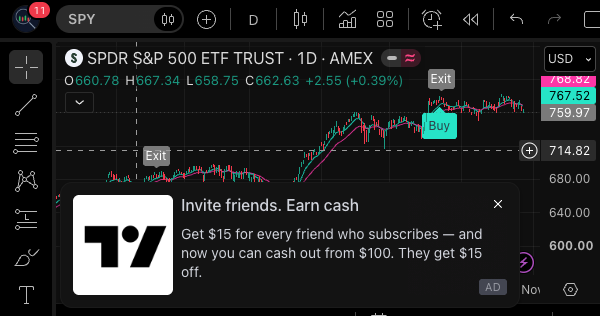
The tool is a trend indicator that leans on price action concepts to frame directional bias. The premise is straightforward: instead of stacking oscillators or lagging averages, it interprets the behaviour of price itself — the way swings form, how structure develops, and which direction the market is leaning. As shown in the chart above, the output is meant to give you a visual read on trend context rather than a cluttered dashboard of signals.
That’s the honest summary. The public material for this indicator is thin on specifics, so I’m not going to invent default settings, thresholds, or signal logic that aren’t documented. What can be said confidently is that the design philosophy is trend-following by way of price action — you’re tracking direction, not chasing overbought/oversold extremes.
Key features
Because the documentation doesn’t spell out individual inputs, I’ll describe the feature set at the level it’s actually supported:
- Trend framing. The core job is to help you identify which way the market is pushing. It’s a directional tool first.
- Price action foundation. Rather than deriving signals from a transformed price series, the indicator is built around reading price behaviour directly — the kind of structure discretionary traders already watch.
- Clean chart intent. Tools in this family typically aim to reduce noise rather than add to it, letting you stay focused on the trend without a dozen overlapping studies.
If you need a full parameter-by-parameter breakdown before installing, you won’t find it in the public description — you’ll have to load it and inspect the settings panel yourself. That’s a fair caveat, not a knock on the tool itself.
How to use it
The sensible workflow for a trend/price-action indicator is to treat it as context, not as a trigger. Use it to establish bias — is the market trending or chopping, and in which direction? — then make your entry and exit decisions with your own method on top. It pairs naturally with structure-based trading: pullbacks into a trend, continuation setups, and avoiding counter-trend entries when the tool is clearly reading one direction.
One thing worth stating plainly: no trend indicator tells you when a trend is about to reverse. Use it to stay on the right side of momentum, not to call tops and bottoms.
Pros and cons
Pros
- Focuses on price action, which many traders find more intuitive than indicator-derived signals.
- Keeps the chart readable — trend tools tend to be less noisy than oscillator stacks.
- Fits naturally into a discretionary, structure-first process rather than forcing a rigid system.
Cons
- The public documentation is thin, so you’re partly trusting the tool on faith until you explore it yourself.
- Trend indicators lag by nature; price-action framing doesn’t change that fundamental limitation.
- Without documented specifics, it’s hard to compare it objectively against alternatives before installing.
Who it’s for
This suits discretionary traders who already read charts structurally and want a second opinion on trend direction — swing traders and intraday trend-followers in particular. It’s less useful for anyone hunting a fully mechanical, plug-and-play signal system, and it won’t rescue a trader who hasn’t developed their own entry/exit rules.
FAQ
Is it a signal or a context tool? Based on its price-action trend design, treat it as context — bias and direction — rather than a standalone buy/sell trigger.
Does it work on any timeframe? Trend logic is timeframe-agnostic in principle, but I won’t claim a “best” timeframe without documented evidence. Test it on the timeframes you actually trade.
Can I use it alone? You can, but it’s stronger as part of a process that includes your own risk management and entry rules.
Final verdict
Algoz Pro Price Action is a reasonable, focused trend tool built on a philosophy many traders already trust: read the price, follow the trend. The thin public documentation is the main frustration — you don’t get a full spec sheet before committing — but the concept is sound and the category fit is honest. It earns a solid four stars: good at what it sets out to do, without the transparency that would push it higher.
⭐⭐⭐⭐
Not financial advice. Verify any indicator’s behaviour on your own charts before risking capital.
Go Deeper with The Indicator Lab
🔬 The Lab Report — 123 indicators. 20 markets. One consensus verdict every 15 minutes. Stop guessing which indicator to trust.
📈 The Lab Edge — Time-Series Momentum across 166 markets. The same framework institutions use. Weekly signals to your phone.
📊 Prefer to trade on your own? Power your analysis on TradingView — the platform behind every review on this site.
Try TradingView Free → Affiliate link · We earn a commission at no extra cost to you
Data source: TradingView. This review is based on publicly available indicator information and the official TradingView script documentation. Always test indicators in a demo environment before live trading.
Chart full of indicators. Still not sure which one to trust.
You just read about Algoz Pro Price Action Review — Trend Indicator. Add 10 more to your chart and you're drowning in conflicting signals. The Lab Report runs 123 indicators on 20 markets, tallies the consensus, and pings your phone every 15 minutes. Less clutter. One verdict.
What is the Lab Report? See how the consensus engine works →
Got your entries? Now what?
The Lab Edge runs Time-Series Momentum — the same framework institutions use — across 166 markets, 95% profitable in backtesting. One signal. Once a week. No indicators to configure.
Upgrade to Pro
LAB ORIGINALThis free trend, technical analysis indicators work — but if you want phone alerts, multi-timeframe scanning, and zero repaint, here's what we built:
🔬 Are you the developer of this indicator? Email us →